
For organizers
Arithmetic is not your job
Pairings, rotations, who has not played whom, the running table, who owes what for the court. It is arithmetic, and arithmetic is exactly where amateur tournaments fall apart. Set the format and stop counting.
- A dozen formats, from a four-player Americano to a month-long championship
- Draws, rotations and seeding generated automatically
- The table recomputes as scores come in
- Made a mistake or lost a player? You fix it yourself, not through support
- 10+tournament formats
- 4–32+players per tournament
- $0cost to the organizer
- 13+languages for participants
Control
The tournament runs, and life keeps happening
Somebody pulls a back in round three. The wrong score gets entered. The event gets marked finished a round early. In most services that is a support ticket and a ruined evening. Here it is three taps and you have fixed it yourself.
Swap a player mid-tournament
Who replaces them and for how many rounds is your call. The rounds the departing player already played stay in the record rather than vanishing with them.
Drop somebody into an empty slot
Arrived five minutes after the start — not a problem. The free place is filled straight from the roster.
Correct a score already entered
Typed the wrong number, fix it. The table recomputes immediately for everyone.
Roll a result back
Delete a result and every player's rating returns to what it was before that match, and the standings rebuild. Nothing is left miscounted.
Undo a start or a finish
Hit "Finish" too early — put the tournament back in play and carry on. Started with the wrong line-up — undo the start.
All of it without a support ticket
The organizer owns the tournament. Nobody waits on a chat reply while twelve people stand on court.
Formats
Plenty to choose from
Americano and Mexicano turn up in every app. What follows is what almost nobody has.
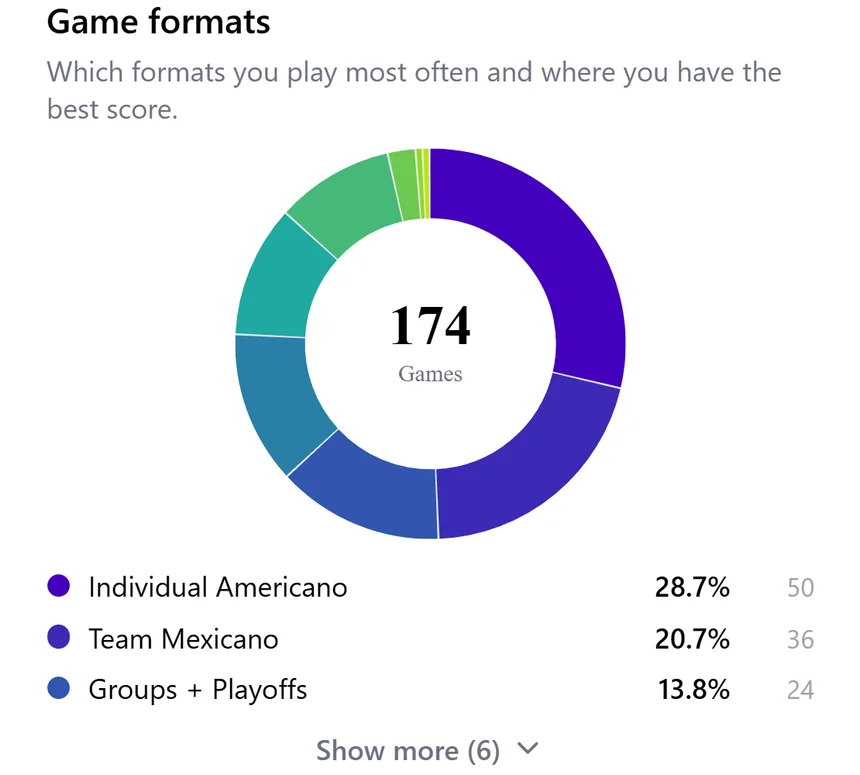
Americano and Mexicano
In Americano the partner changes every round on a fixed schedule, so everyone plays with everyone. In Mexicano the next round is drawn from the current table, which keeps games level all evening. Both come in individual and team versions.
Divisions
A ladder of championships. The first division is the strongest; at the end of a cycle the best move up and the worst move down. It fits a club that plays with the same crowd every week.
Groups + playoffs
The classic. Groups are seeded in a snake by rating so they come out even in strength, then it is knockout.
Court ladders
Courts stacked top to bottom, the first one called the Throne. Winners climb, losers drop, and a win on a higher court is worth more. There are versions in fixed pairs and a version where one player leaves the court rather than a pair — there everyone answers for themselves.
Swiss system
Each round the opponents are picked to make the match as even as possible while keeping your partners across the event as varied as possible. On equal points whoever drew the stronger opponents ranks higher.
A championship over several weeks
A group of four to six pairs, everyone plays everyone, then playoffs. Times are not scheduled: opponents agree between themselves and set the match. The stages have deadlines, and it runs itself from there.
What the app takes over
The work you stop doing
Draws and rotations
Built from the format and the entry list. Change the number of courts mid-event and the schedule rebuilds around it.
A live table
Scores go in from any phone and the table updates for everyone at once. There is nothing left to argue about.
A reserve list of its own
People who did not get a spot wait in the reserve. Somebody drops out, you move a reserve player into the roster with one tap.
Entry fee as a real field
An amount and a currency, not a line in the description. It shows on the card, works in filters, and payment details attach to the game.
Private games
You decide who gets into the roster and who sees the join code. The game still shows in the feed — hiding it from everyone is rarely what you want.
Notifications instead of your messages
Round starts, court assignments, changes, results. Plus game alerts: a player sets their conditions once and hears about every game that fits.
Audience
Who comes to your games, in numbers
A separate tab in your profile: not "how many events you ran" but who turns up to them and whether they come back. Plus an anonymous rating from participants.
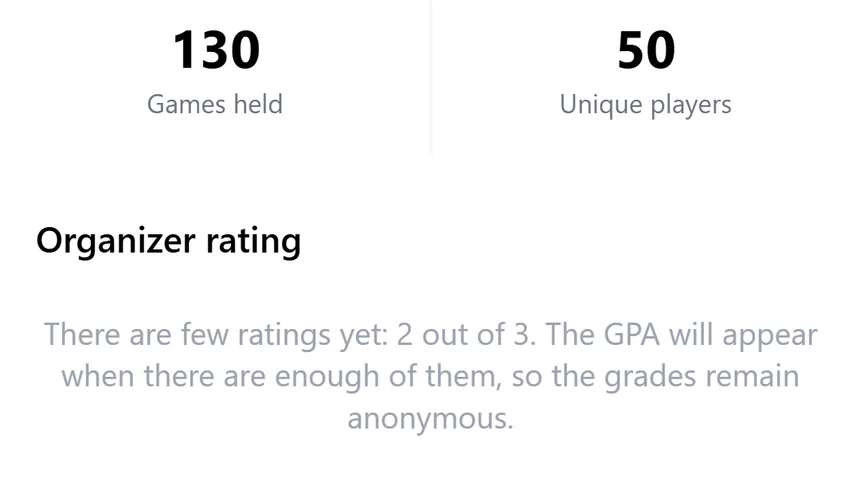
Repeat attendance
The organizer's number. Everyone comes once; the second time is only the people who enjoyed it.
Popular formats
Which formats actually fill up, and which ones you keep running out of habit.
Average player level
What level shows up to you. It tells you whether to announce the next one for beginners or the opposite.
Gender, age and interests
A portrait of your audience. It hints at what conditions and what times to pick.
Activity by time of day
When people actually go out to play. It usually disagrees with when you schedule games.
Your core players
The people who come most often. The whole event rests on them, and theirs is the opinion to ask first.
How to run one
From idea to final in four steps
Create the tournament
Format, date, venue, courts, player limit, level range. Two minutes and the draw structure exists. If the format is unfamiliar, there is a "how do you play this" button right next to its name.
Fill the field
Send the link to your regulars, or publish it to the feed so players in your city at the right level register themselves. Anyone who does not fit goes to the reserve.
Run it from your phone
Start rounds, enter scores, watch the table. Anything that goes wrong is fixed on the spot.
See how it went
Final table, every match on record, updated ratings for everyone, and anonymous feedback from the players.
Organizer questions
What does running a tournament cost?
Creating and running them is free, with no cap on how many. Some of the heavier formats and the deeper audience analytics can sit behind a subscription.
What is the difference between Americano and Mexicano?
In Americano the rotation is fixed in advance: everyone plays with everyone regardless of results. In Mexicano each round is built from the current table, so people near each other in the standings end up on the same court. Americano is the more social one and suits a mixed group; Mexicano keeps games close to the last round and suits a regular club night.
How many players fit?
From four up to a large draw, depending on the format and how many courts you have. The app checks in advance whether your field fits the schedule given your courts and round length.
A player left in the middle. What now?
Replace them mid-event — you choose who steps in and for how many rounds. The rounds the departing player already played stay in the record. No support ticket needed.
We entered the wrong score. Can it be fixed?
Yes. Scores can be corrected, and a result can be deleted outright — every player's rating then returns to what it was before that match and the standings rebuild. A mistakenly pressed "Finish tournament" is undone the same way.
Do participants need the app?
They need an account, which they can create in a browser or in Telegram without installing anything. Without it there is no live table and no result in their rating.
Your first tournament takes two minutes to set up
Pick a format, set a date, share the link.